Social media marketing in 2026 has fundamentally transformed from connection-building to commerce-driven strategies, requiring brands to adapt their approach for 2026’s evolved landscape.
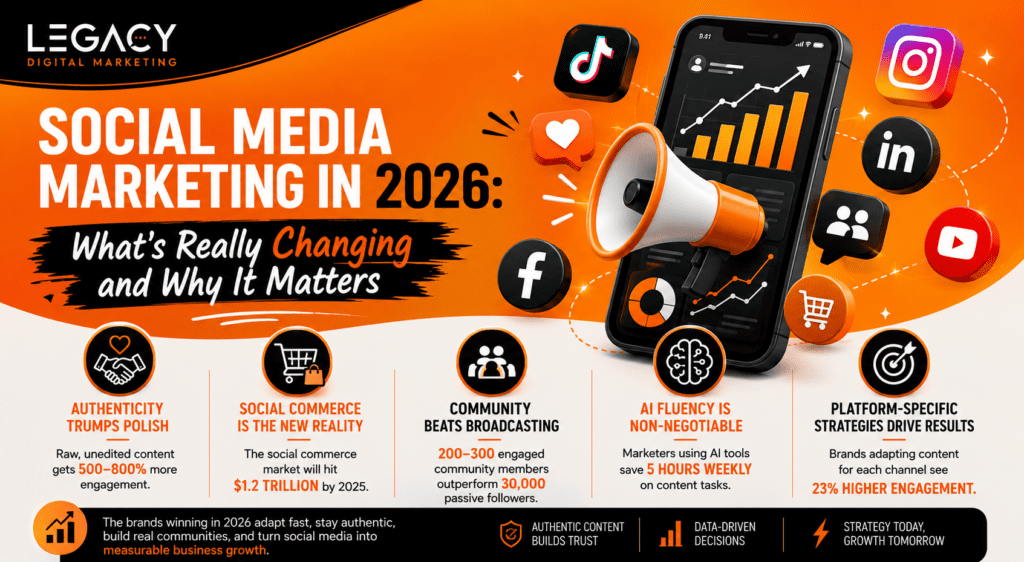
• Authenticity trumps polish: Raw, unedited content generates 500-800% more engagement than professionally produced material as audiences crave genuine connections over corporate perfection.
• Social commerce is the new reality: With $1.2 trillion projected by 2025, platforms have become storefronts where discovery and purchase happen seamlessly within feeds.
• Community beats broadcasting: Focus on building smaller, deeply engaged audiences rather than chasing massive passive followings—200-300 engaged members outperform 30,000 passive followers.
• AI fluency is non-negotiable: Marketers using AI tools save 5 hours weekly on content tasks, freeing time for strategy and human connection that algorithms can’t replicate.
• Platform-specific strategies drive results: Brands adapting content for each channel see 23% higher engagement than those posting identical material everywhere.
The brands winning in 2026 treat social media as a measurable business investment with direct performance outcomes, not a side channel for occasional posts. Success requires choosing platforms strategically, understanding actual audience behavior, and building sustainable processes that balance automation with authentic human connection.
Social media marketing in 2026 is entering uncharted territory with 5.66 billion active users worldwide, representing nearly 69% of the global population. Traditional marketing approaches no longer deliver results because audience behaviors have fundamentally shifted. Consumers now prioritize authenticity over polish, community over broadcasting, and commerce-ready content over passive scrolling. With this in mind, you need updated social media marketing tools, fresh strategies, and an understanding of the latest social media trends to stay competitive. This guide covers what’s changing in 2026, which social media trends matter most, and how to build a social media marketing strategy that actually works.
What’s Fundamentally Different About Social Media Marketing in 2026
The transformation from connection to commerce
Platforms have stopped being places where you simply build awareness. The global social commerce industry grew from $492 billion in 2021 and is projected to reach $1.2 trillion by 2025, expanding three times faster than traditional e-commerce. This shift reflects how Instagram Checkout, TikTok Shop, and Facebook Marketplace now blend social interaction with instant purchasing.
One in four connected consumers shopped via social media in 2024, driving $335 billion in sales. By 2029, social commerce will account for over 5% of global e-commerce. Accordingly, your social media marketing strategy must account for the entire customer journey, from discovery to checkout, happening within a single platform. Shoppable posts, live-stream shopping experiences, and in-app payment systems have turned feeds into storefronts where entertainment and transactions merge seamlessly.
Audience behavior and expectations
Your audience isn’t using social media the same way they did two years ago. Around 78% now discover products directly on TikTok, Instagram, Pinterest, and YouTube Shorts. For instance, nearly half of Gen Z and 51% of millennials use social platforms to search for restaurant recommendations, recipes, and product information instead of Google. This behavioral shift means you need social SEO optimization, not just traditional search engine strategies.
Trust dynamics have fundamentally changed. While 70% of consumers look for user-generated content before buying (double from last year), trust in traditional influencers dropped 10-12 percentage points between 2020 and 2024. Your audience now gravitates toward micro-influencers and peer recommendations over celebrity endorsements. The data shows 74% of shoppers converted from influencer content in 2026, but only when that content felt authentic.
Engagement expectations have also shifted:
- Response requirements: 76% of consumers feel more loyal to brands that reply to comments or messages, while 52% are less likely to buy from brands that don’t respond
- AI skepticism: 63% of users are less likely to engage with AI-generated visuals, and nearly half form negative opinions when brands use AI for customer replies
- Community focus: Consumers want personalized content, privacy protection, and community building over public broadcasting
Why traditional strategies no longer work
Platforms evolve faster than most social media marketing approaches can adapt. Organic reach continues declining while paid media costs climb steadily. The algorithms reward speed and cultural relevance, expecting brands to respond to trending moments almost instantly. If you’re still planning content weeks in advance without flexibility for real-time adaptation, you’re operating with an outdated social media marketing strategy.
Generic content strategies produce no results in 2026 because different generations respond to completely different cultural signals. What builds trust with Gen Alpha alienates Gen X, despite Gen X holding the biggest wallets. Notably, businesses that fail to understand platform-specific strategies, audience engagement patterns, and analytics consistently struggle to create compelling content. Without dedicated resources toward social media marketing tools and continuous research, your efforts become inconsistent and ineffective.
The brands succeeding now treat social media as a measurable business investment connected directly to performance outcomes, not a side channel for occasional posts.
Latest Social Media Trends Reshaping Marketing Strategies
Authenticity over polish: The raw content revolution
Instagram CEO Adam Mosseri declared 2026 “The Year of Raw Content,” marking an algorithm shift that rewards imperfect content including poor lighting, shaky camera work, and unedited posts. Authenticity has become the clearest trust signal on social media. Research shows 77% of consumers engage more with genuine, relatable content, while 93% of marketers report user-generated content outperforms traditional branded material.
Raw content works because audiences recognize patterns quickly. When your values, voice, and actions align consistently over time, people identify your presence without checking the username. Phone-shot videos generate 500-800% more engagement than professionally produced content. This shift doesn’t mean unprofessional execution. In essence, it means letting real personality show through rather than hiding behind stock imagery and corporate language.
Community-first platforms and niche audiences
Users are migrating toward platforms emphasizing genuine connection over broadcasting. Reddit grew 19% year-over-year to reach 116 million users in Q2 2025, while Substack saw a 67% increase from 28 million to 47 million unique visitors between September 2024 and September 2025. WhatsApp now has 2.9 billion users worldwide, and Discord hosts 689 million users spending 3.4 hours weekly on the platform.
These community-first spaces support conversation instead of performance through WhatsApp channels, Instagram Broadcast Channels, and Discord servers. Brands investing in smaller, engaged communities see better returns than chasing massive passive audiences. Having 200-300 deeply engaged members outperforms 30,000 passive followers.
Creator economy and influencer evolution
Creator marketing budgets grew 171% year-over-year, with 71% of organizations increasing investment. Brands now treat creator partnerships as permanent budget line items, not experimental channels. The market reached $33 billion in 2025, up from under $10 billion in 2020.
Micro-creators with 10,000-100,000 followers deliver higher engagement rates while costing 60-70% less than macro-influencers. Their recommendations feel like friend suggestions rather than advertisements. Coupled with this shift, 44.9% of creators prefer long-term partnerships over one-off campaigns, recognizing that sustained collaborations produce more authentic content.
Nostalgia and personalization trends
Nostalgia marketing taps into emotional connections during uncertain times. When audiences feel unstable, they naturally look backward to re-anchor themselves. This strategy works because 92% of consumers prefer brand messages that feel like stories rather than advertisements, and stories prove 22 times more memorable than facts alone.
Social media enables nostalgia through preserved cultural moments and memes. Brands using founder-led stories see 55% higher purchase intent and 20% more loyalty. The key involves blending iconic elements with contemporary design, creating campaigns that feel both fresh and comfortingly familiar.
Video format shifts: Short, mid, and long-form
Short-form vertical video remains deeply embedded in digital infrastructure and won’t fade soon. TikTok’s engagement rate hit 3.70% in 2025, driven by spontaneous content algorithms favor. However, long-form content offers substantial benefits for social media marketing strategies. Longer videos keep viewers on pages longer, generate more backlinks, and show 34% higher conversion rates.
The most effective approach balances both formats. Short videos introduce brand personality and stop scrolls, while long-form content allows deep dives into complex topics. Platforms like YouTube favor extended content for algorithm purposes, whereas TikTok and Instagram prioritize quick, digestible clips.
Essential Social Media Marketing Tools and Technologies
AI-powered content creation tools
The best software in 2026 handles content production’s heavy lifting, enabling you to focus on strategy and human connection. AI-powered captioning uses advanced language models to draft platform-specific captions matching your brand voice and including trending hashtags. Automated content repurposing takes existing assets like blog posts and slices them into social-ready updates.
Buffer, Hootsuite, Agorapulse, and other major platforms have integrated AI assistants faster than AI-first startups built out social features. These tools generate posts, rephrase drafts, create ideas, and catch errors. Marketers using generative AI save five hours per week on content tasks. That recovered time goes directly toward strategy, audience research, and creative decisions algorithms cannot replicate.
Social listening and analytics platforms
Brands relying on text-only monitoring operate with a 75% data deficit. Traditional social listening platforms miss imagery, audio, and video content dominating the internet. In 2026, Automatic Speech Recognition captures brand mentions in podcasts and videos that text crawlers never hear, while Optical Character Recognition reads visual logos appearing in untagged content. Computer Vision extends beyond text to interpret facial expressions and contextual backgrounds.
Modern analytics tools provide predictive insights, competitor analysis, and detailed audience behavior breakdowns. Platforms like Sprout Social, Metricool, and Hootsuite offer real-time reporting dashboards showing which content formats, topics, and posting times generate highest returns. Sentiment analysis detects emerging trends and emotional resonance, while predictive analytics forecast future engagement patterns months ahead.
Commerce integration tools
Social commerce represents a paradigm shift in consumer-brand interaction. Shoppable video enables shoppers to add items to cart without exiting the app. Tools like Tolstoy help e-commerce brands turn social-style video into shoppable storefront experiences while supporting content creation through AI product suites. Instagram Shopping lets businesses tag products in posts so profiles function like storefronts. Shoppers explore product details in-app and complete purchases either within Instagram or on merchant websites.
Automation and scheduling systems
Modern scheduling platforms use predictive analytics and machine learning to determine optimal publishing times. These systems adjust automatically based on changing algorithms, engagement drops, or new platform features. Tools can pause campaigns during breaking news, shift posting windows based on real-time activity, and recommend format changes for improved performance. Hootsuite’s bulk-scheduling capability allows uploading weeks of content in advance while maintaining flexibility to pause scheduled posts during brand crises.
Building an Effective Social Media Marketing Strategy for 2026
Audit your current approach
Start by documenting every active social profile your brand maintains. Record each platform’s URL, follower count, update frequency, and engagement rates. Check profile completion across all accounts to ensure every input field contains current information. Your logos, names, and brand colors should remain consistent across platforms, though content can vary to match each platform’s unique aspects.
Engagement metrics reveal which marketing techniques successfully hit established goals versus which need revision. Track how frequently viewers respond to posts and whether engagement rises with frequent posting or selective updates. According to research, businesses conducting regular audits see 47% higher engagement rates than those posting without strategic analysis.
Choose priority platforms based on audience
Social media works best when goals align with overall company objectives beyond just marketing. Your product team might prioritize customer satisfaction scores while marketing focuses on conversions. Map audience behavior using social intelligence tools to identify which profiles generate highest impressions and engagement. If certain profiles consistently outperform others, dig into why.
Perform competitive gap analysis to find insights you might miss when focusing solely on your efforts. If competitors thrive on particular channels, it signals exploring your presence there too. Focus on one or two platforms really well rather than stretching resources across multiple channels.
Define sustainable content creation processes
Batch tasks requiring the same energy level to enhance productivity. A sustainable publishing frequency feels like you haven’t done enough rather than overwhelming your capacity. Consistency with one weekly content piece 52 times beats publishing daily for two weeks then quitting for six months. Creating less helps develop a creative habit without burning out.
Implement social SEO practices
Social profiles function as miniature landing pages. Include target keywords describing your content 1-2 times in post captions with the first mention at the beginning. Use alt text for images as both an accessibility standard and SEO tool. When including links, ensure the webpage is also optimized for the keyword in your post. Stay consistent with messaging across platforms to reinforce brand authority.
Plan for multi-platform attribution
Multi-touch attribution recognizes every interaction contributing to conversions rather than crediting only the final click. A TikTok video might spark interest while Instagram DMs answer objections and LinkedIn ads finalize deals. Attribution reveals when customers feel overwhelmed with repetitive content, allowing teams to design sequences that educate and convert without overloading buyers.
Create a now/next/later framework
This roadmap categorizes tasks into three segments: Now (immediate attention), Next (short-term priorities), and Later (long-term objectives). The framework’s flexibility allows easy adjustment to reflect changing priorities or market conditions. Teams can quickly pivot without rewriting entire roadmaps. Break work into manageable steps that stop teams from feeling overwhelmed while staying focused on customer needs.
Social Media Marketing Services and Skills That Matter Now
AI fluency as a core competency
Marketers need working knowledge of AI systems beyond basic chat interfaces. According to research, 56% of companies actively implement AI tools, with half using them for content creation, 51% for optimization, and 43% for task automation. This competency involves understanding how AI handles personalization, content generation, influencer identification, customer service workflows, and advertising optimization. The skill centers on crafting effective prompts, evaluating AI outputs critically, and integrating these capabilities into repeatable workflows rather than one-off experiments.
Social commerce expertise
Understanding platform-specific shopping features has become non-negotiable. Professionals must know how TikTok Shop, Instagram Checkout, and Facebook Marketplace function operationally. This expertise includes creating shoppable posts, managing product catalogs within social apps, and understanding how social proof influences purchase decisions without users leaving platforms. The knowledge extends beyond posting products to optimizing the entire in-app purchase journey.
Community management and engagement
Building active communities ranks as crucial for 86% of social media marketers. Community management represents the human side of brands, operating both on social platforms and through owned channels. This skill requires consistent value delivery beyond products, understanding member pain points, and fostering peer-to-peer interactions that strengthen brand loyalty organically.
Content strategy for different platforms
Platform-specific customization drives results. Brands adapting content for each channel see 23% higher engagement compared to those posting identical material everywhere. Successful strategists understand that Instagram thrives on visual storytelling, LinkedIn favors professional insights, and TikTok rewards trend-responsive authenticity. This requires analyzing platform algorithms, audience demographics, and format preferences to optimize performance across channels.
Conclusion
Social media marketing in 2026 demands a completely different mindset than what worked even two years ago. Authenticity beats perfection, commerce happens within feeds, and community building outperforms broadcasting. Without a doubt, the tools and strategies covered here give you the foundation to compete effectively in this transformed space.
Success comes from choosing platforms strategically, understanding your audience’s actual behavior patterns, and treating social media as a measurable business channel. If you implement even a few of these approaches, you’ll see measurable improvements in engagement and conversions. Start with an honest audit, focus on one platform really well, and build from there.
FAQs
Q1. Why is social media marketing so different in 2026 compared to previous years? Social media has fundamentally transformed from connection-focused platforms to commerce-driven ecosystems. With 5.66 billion active users worldwide, platforms now blend social interaction with instant purchasing through features like Instagram Checkout and TikTok Shop. Audience behaviors have shifted dramatically—consumers now prioritize authenticity over polished content, use social platforms as search engines instead of Google, and expect brands to respond in real-time to trending moments. Traditional strategies fail because algorithms evolve faster than most marketing approaches can adapt.
Q2. What types of content perform best on social media in 2026? Raw, authentic content significantly outperforms polished, professionally produced material. Phone-shot videos generate 500-800% more engagement than studio-quality content, and 77% of consumers engage more with genuine, relatable posts. User-generated content outperforms traditional branded material, with 93% of marketers reporting better results. The key is consistency in voice and values rather than perfect production quality, allowing real personality to show through instead of hiding behind corporate language.
Q3. Should brands focus on influencer marketing or build their own communities? Both strategies work, but the approach has evolved. Micro-creators with 10,000-100,000 followers deliver higher engagement rates while costing 60-70% less than macro-influencers, and their recommendations feel more authentic. However, building owned communities of 200-300 deeply engaged members often outperforms having 30,000 passive followers. The most effective strategy combines long-term creator partnerships with community-first platforms like Discord, WhatsApp channels, and Reddit where genuine conversations happen.
Q4. What social media marketing tools are essential for 2026? AI-powered content creation tools that handle captioning, repurposing, and idea generation save marketers approximately five hours per week. Advanced social listening platforms using Automatic Speech Recognition and Computer Vision capture brand mentions across video, audio, and images—not just text. Commerce integration tools like shoppable video and Instagram Shopping enable in-app purchases, while automation systems use predictive analytics to determine optimal posting times and adjust strategies based on real-time performance data.
Q5. How do I create a social media strategy that actually works in 2026? Start with a comprehensive audit of your current profiles, engagement metrics, and content performance. Choose one or two priority platforms based on where your specific audience actually spends time rather than spreading resources thin. Implement sustainable content creation processes with consistent publishing schedules, even if that means posting less frequently. Incorporate social SEO practices by including keywords in captions and alt text, and plan for multi-platform attribution to understand the full customer journey across different touchpoints.
