If you’ve ever wondered whether you should invest in Google Local Search Ads or double down on your organic local SEO, you’re not alone. Business owners, marketers, and even savvy side hustlers are asking the same thing: What really drives more conversions — paid or organic local search? Spoiler alert: the answer is not as black and white as you might think.
In today’s mobile-first, location-based world, both Local Search Ads (LSAs) and organic listings have power. But how you use them and more importantly, how they convert can massively impact your bottom line. This article breaks down the pros, cons, costs, and conversion potential of both. Let’s settle this.

What Are Google Local Search Ads (LSAs)?
Local Search Ads are paid placements that show up when users search for services near them. They typically appear at the top of Google Maps and local search results complete with reviews, call buttons, directions, and sometimes even hours of operation.
These ads are designed for immediate action. A user types in “dentist near me,” and boom, your listing is pinned with a click-to-call button right at the top.
What Is Organic Local SEO?
Organic local SEO refers to the unpaid local results that show up below ads on Google’s search engine results pages (SERPs). These results come from well-optimized Google Business Profiles, high-quality local content, backlinks, and consistent citations across the web.
Organic traffic builds over time. It doesn’t cost per click, but it requires effort, content, and patience.
Conversion Rate: Paid vs Organic Local Listings
So, which one really gets the phone ringing?
Google Local Services Ads
- Share of Local Search Clicks: About 13.8% when Local Services Ads are displayed.
- Top LSA Position: The first LSA receives about 7.4% of all clicks on the local search results page.
- Lead-to-Customer Conversion: Around 31% in recent contractor benchmarks, although results vary by industry, location, reviews, pricing, and response time.
- Lead Quality: High-intent users who are actively searching for a nearby service provider and can call or contact the business directly from the ad.
Organic Local Search
- Share of Local Search Clicks: Organic results receive about 43.9% of clicks even when Local Services Ads are present.
- Top Organic Position: The #1 organic result can capture about 25.5% of all clicks on a local search results page.
- Visitor-to-Lead Conversion: Around 4.2% is a recent median benchmark for local home service websites, while stronger-performing sites can reach roughly 7.1% or higher.
- Lead Quality: Mid- to high-intent users who may spend more time researching reviews, services, pricing, and business credibility before contacting a company.
Verdict
Local Services Ads can generate customers faster because the people contacting the business are already high-intent leads. Recent contractor benchmarks put LSA lead-to-customer conversion around 31%.
Organic search plays a different role. It captures a much larger share of local search clicks, with organic results accounting for roughly 43.9% of clicks when LSAs are present. Strong local service websites can turn around 4% to 7% or more of organic visitors into leads.
For businesses that want immediate leads, LSAs have an advantage. For sustained visibility, lower long-term acquisition costs, and continued lead generation, organic search remains extremely valuable.
Budgeting: What Costs More?
Google Local Services Ads
Google Local Services Ads use a pay-per-lead model, not pay-per-click.
You are charged when a potential customer sends a valid lead, such as:
- A phone call
- A message
- A booking request
Typical LSA Costs
Lead costs vary based on your industry, location, competition, service type, and bidding strategy.
For home-service businesses in 2026:
- Typical range: $25 to $90 per lead
- Many trades: $39 to $60 per lead
- HVAC: About $51 per lead
- Plumbing: About $57 per lead
- Electrical: About $39 per lead
Highly competitive markets can cost more.
LSAs can generate leads quickly, but you continue paying as long as you want paid leads. You can control your budget and set spending limits based on your advertising goals.
Organic SEO
Organic SEO does not charge you for every click or lead, but it still requires an investment to build and maintain rankings.
Common SEO Costs Include
- Content creation
- Technical SEO
- Google Business Profile optimization
- Local citations
- Review management
- Link building
- Ongoing website improvements
Typical Local SEO Costs
Local SEO pricing varies based on competition, business size, number of locations, and the amount of work required.
- Average monthly cost: About $1,557
- Common range: $250 to $1,000 per month for 42% of SEO providers
Why Businesses Invest in Organic SEO
Unlike LSAs, you are not paying for each individual click or lead.
Organic SEO usually takes longer to build momentum, but strong rankings can continue generating:
- Website traffic
- Phone calls
- Form submissions
- Local leads
The main advantage: Once your organic visibility improves, your business can continue attracting potential customers without paying Google for every inquiry.
ROI Tip
For many local businesses, using LSAs and local SEO together is more effective than relying on only one channel.
- LSAs: Generate leads quickly.
- Local SEO: Builds long-term organic visibility.
- Together: Help create a more balanced lead strategy.
As organic traffic grows, your business may rely less on paid leads, which can help lower customer acquisition costs over time.
What to Measure
Focus on business results, not just ad spend or SEO costs:
- Cost per qualified lead
- Cost per booked customer
- Lead-to-customer conversion rate
- Revenue generated
A $50 LSA lead can be profitable if it turns into a valuable customer. Organic leads can become more cost-effective over time as SEO continues generating traffic without paying for each inquiry.
Trust & Visibility: Where Do Users Click?
Both organic results and Local Services Ads can earn clicks, but for different reasons.
Organic Search: Strong reviews and a complete Google Business Profile can influence which businesses customers choose. Recent consumer research found that 92% of consumers consider star ratings when choosing a business, while 31% will only use businesses rated 4.5 stars or higher. Positive reviews also make 85% of consumers more likely to choose a business.
Local Services Ads: LSAs appear prominently in Google search results and display useful trust signals such as ratings, reviews, and contact options. This can help businesses attract high-intent customers who are ready to call, message, or book a service.
Click research has also shown that when LSAs appear, they can capture about 13.8% of clicks, while organic results receive around 43.9%. The top organic result alone can receive roughly 25.5% of clicks.
The takeaway: LSAs offer immediate visibility, while organic search can capture a larger share of clicks and build long-term trust. Using both can help local businesses stay visible throughout the customer journey.
Mobile-First Behavior: Local Search Starts on the Phone
Mobile plays a major role in local search. According to 2026 consumer search research, 73% of consumers started their most recent search for a local business on a mobile phone, compared with 19% on a computer and 8% on a tablet.
This matters because local customers often want quick access to practical information such as services, reviews, business hours, directions, and contact options. Google Local Services Ads can appear prominently in Search and allow potential customers to call or message a business directly. Eligible businesses can also offer booking through their ads.
Pro Tip: Keep your Local Services Ads profile accurate and complete, respond to leads quickly, and make sure your website is mobile-friendly. Your Google Business Profile should also have current hours, services, photos, contact information, and reviews.
Use Case: Service-Based Businesses
Google Local Services Ads work especially well for businesses that depend on local leads, including:
- HVAC
- Plumbing
- Electrical
- Water and fire restoration
- Pest control
- Locksmith services
- Cleaning services
- Dental practices
- Legal services
Why LSAs Work
- High Search Intent: People searching for “emergency plumber near me” or “AC repair near me” often need help now.
- Strong Visibility: LSAs can appear near the top of Google Search results.
- Easy Contact: Customers can call or message the business directly from the ad.
- Trust Signals: Ratings, reviews, and business details help customers compare providers quickly.
- Faster Lead Generation: LSAs can generate leads without waiting for organic rankings to improve.
The takeaway: LSAs are useful for generating immediate local leads, while organic SEO builds visibility and traffic over the long term.
Use Case: Multi-Location Businesses
Businesses with multiple locations can benefit from using local SEO and Local Services Ads together.
Organic SEO Helps Each Location Grow
- Individual Visibility: Each eligible location can have its own Google Business Profile.
- Consistent Information: Keep business names, categories, addresses, hours, and services accurate across locations.
- Local Rankings: Location pages, reviews, citations, and optimized profiles can help individual locations compete in local search.
- Long-Term Value: Organic traffic does not require paying for every lead.
LSAs Add Immediate Coverage
- Faster Visibility: LSAs can help newer locations generate leads before organic rankings improve.
- Local Targeting: Businesses can choose the cities or ZIP codes they want their ads to serve.
- Budget Control: LSA budgets can be adjusted based on how many leads a business wants to receive.
- Lead Generation: Ads can generate calls, messages, and other qualified customer inquiries.
Important: If multiple business locations serve the same area, Google says it will show only the highest-ranking LSA from those locations for a search.
The takeaway: Use organic SEO to build long-term visibility for each location and LSAs to support markets where you want leads sooner.
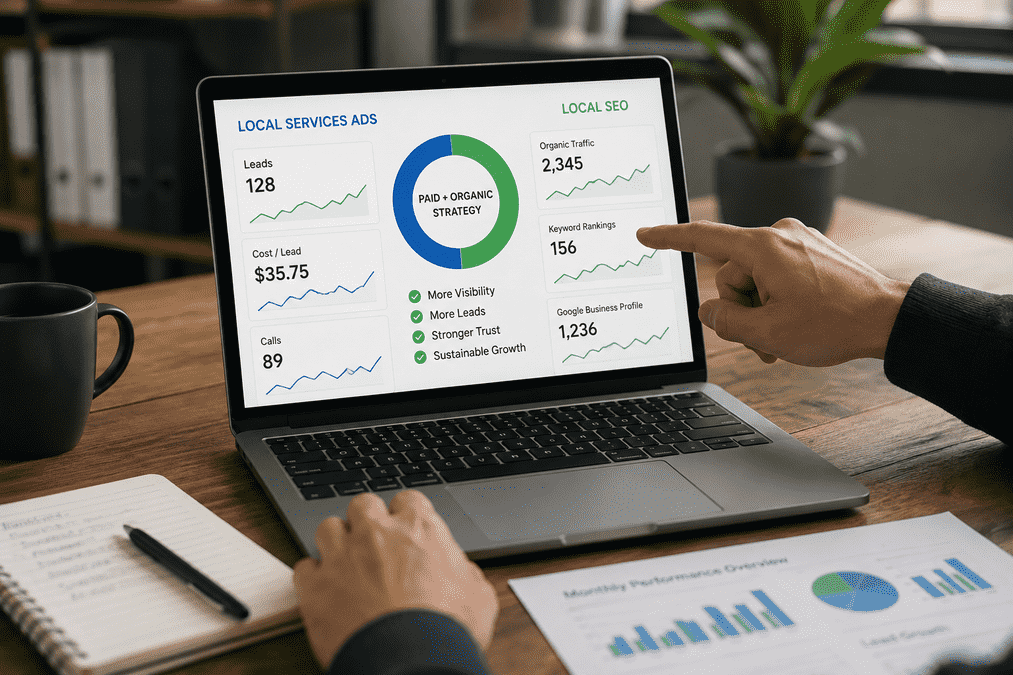
Pro Tip: Blend Paid and Organic for Best Results
The smartest brands use both. Here’s why:
- LSAs capture immediate leads
- Organic SEO builds credibility and trust over time
- Combining them creates full visibility across SERPs and Google Maps
Final Verdict: What Converts Better?
If your goal is fast lead generation, Google Local Services Ads usually have the advantage. They put your business in front of high-intent searchers who are ready to call, message, or book.
If your goal is long-term visibility and steady organic traffic, local SEO is the better foundation. It takes more time to build, but strong rankings can keep generating leads without paying for every inquiry.
The best strategy is often to use both:
- LSAs for immediate visibility and leads
- Local SEO for long-term rankings and trust
- Both together for stronger local search coverage
When potential customers see your business in paid results, organic search, local listings, and reviews, you create more opportunities to earn the click.
Want a strategy built around both? Legacy Digital Marketing helps local businesses combine paid and organic search to generate more qualified leads and build sustainable growth.
Frequently Asked Questions
Google Local Services Ads are paid placements that help eligible businesses generate leads from local searches. Local SEO focuses on improving unpaid visibility in Google Search, Google Maps, and the local pack through your website and Google Business Profile.
Google Local Services Ads use a pay-per-lead model. Businesses are charged for valid leads, such as qualifying phone calls or messages, rather than every click on the ad. Lead costs vary by location, service type, competition, and bidding strategy.
No. Paying for Local Services Ads does not directly improve your organic or Google Maps rankings. Organic local rankings are mainly influenced by relevance, distance, and prominence.
LSA rankings can depend on factors such as your bid, responsiveness, search relevance, location, reviews, ratings, profile quality, and completed verification requirements.
Local organic rankings are mainly based on relevance, distance, and prominence. Complete business information, accurate services, positive reviews, strong ratings, website authority, and a well-maintained Google Business Profile can all support local visibility.
Compare both channels using metrics tied to actual business results, such as qualified leads, cost per lead, booked jobs, conversion rate, customer acquisition cost, and revenue generated. This gives a clearer picture than looking at clicks or rankings alone.