When a homeowner discovers water in the basement, loses heat in the middle of winter, notices a leaking roof, or needs an electrician fast, they usually start with a search.
In 2026, 84% of consumers had searched online for a local business within the previous three months, and 73% started their most recent local business search on a mobile phone. Google also remains a major part of that journey, with many customers beginning on Google Search or Google Maps.
For HVAC companies, plumbers, roofers, electricians, restoration contractors, pest control companies, cleaners, landscapers, and other home service providers, those searches represent real demand.
If your business appears when someone needs the service you provide, you have a chance to turn that search into a call, estimate, appointment, or booked job.
That is where SEO for home service businesses becomes valuable.
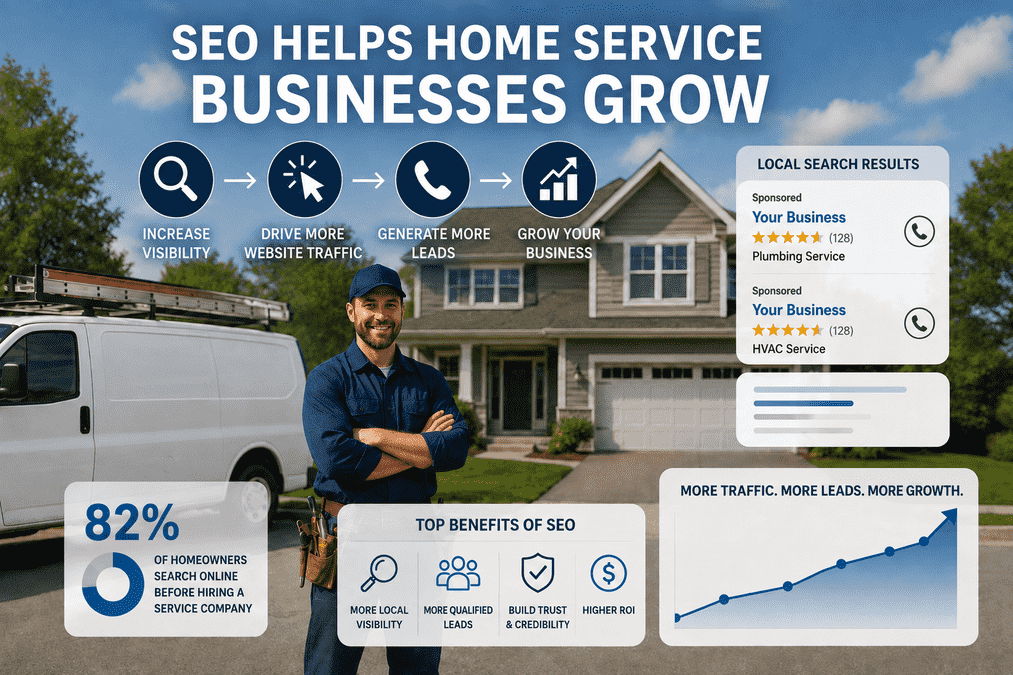
How Does SEO Help Home Service Businesses Grow?
SEO helps home service businesses grow by improving visibility in Google Search, Google Maps, local results, and AI-powered search experiences. It helps contractors reach nearby customers searching for their services, build trust through reviews and useful content, generate qualified leads, and create long-term organic traffic without paying for every individual click or inquiry.
SEO is not just about getting a website to rank.
A strong home services SEO strategy connects your website, Google Business Profile, service pages, location pages, reviews, content, backlinks, technical SEO, and local authority.
The goal is simple: make it easy for search engines and potential customers to understand who you are, what services you offer, where you work, and why your business is worth contacting.
SEO Reaches Customers Who Are Already Looking for Help
One of the biggest advantages of home service SEO is search intent.
Someone searching for “AC repair near me,” “emergency plumber,” “roof leak repair,” “electrician near me,” or “water damage restoration” already has a problem they want solved.
Your marketing does not need to create the need. The need already exists.
SEO helps your business appear at the moment that customer starts looking for a solution.
That is why effective keyword research should go beyond broad terms. A strong strategy should include:
- Service keywords
- Location-based searches
- “Near me” searches
- Emergency terms
- Problem-based queries
- Cost questions
- Comparison searches
- Informational topics
At Legacy Digital Marketing, the goal is not simply to increase website traffic. We focus on helping home service businesses attract searchers who are more likely to become qualified leads and paying customers.
Local SEO Helps You Compete in Google Search and Maps
Homeowners do not always discover contractors through a traditional website result.
They may find a business through Google Maps, a Google Business Profile, the local pack, an organic listing, reviews, or an AI-generated search result.
That makes local SEO for home services especially important.
Google bases local rankings largely on three factors:
- Relevance: How closely your business matches the search.
- Distance: How close your business is to the searcher or searched location.
- Prominence: How established and well-known your business appears online.
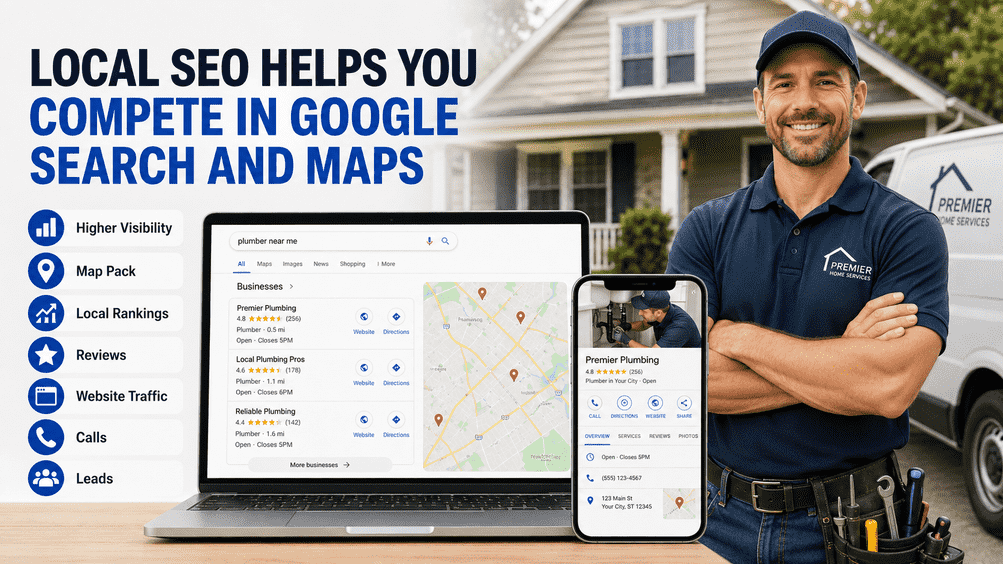
You cannot control where every customer is searching from, but you can strengthen many of the other signals Google uses.
That includes your website, Google Business Profile, services, reviews, local citations, backlinks, content, and overall online presence.
When these pieces support one another, your business has a stronger chance of appearing for the searches that matter.
Your Google Business Profile Can Become a Lead Source
For many home service companies, the Google Business Profile is one of the first things a customer sees.
A complete profile can show:
- Services
- Business hours
- Reviews and ratings
- Photos
- Phone number
- Website
- Service areas
- Business details
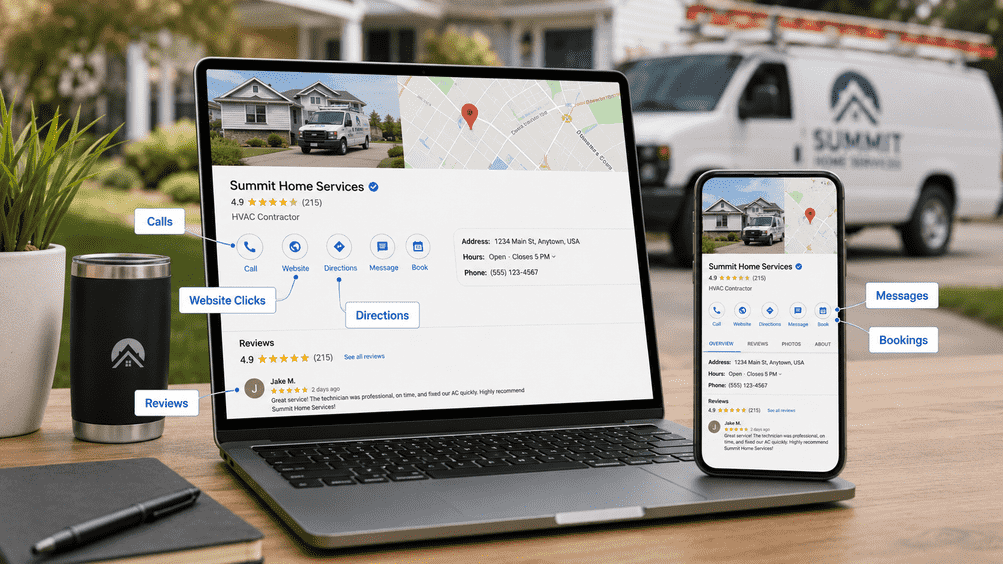
All of that information helps a potential customer decide whether your company looks relevant and trustworthy.
The profile also needs to stay accurate.
Services change. Hours change. New reviews appear. Competitors improve their profiles. Search behavior changes.
Google Business Profile optimization should therefore be treated as an ongoing part of your local SEO strategy, not something you complete once and forget.
Your profile should also match what customers find on your website. If your Google Business Profile lists water heater repair, drain cleaning, or roof replacement, your website should clearly support those services with useful information.
That consistency makes your business easier for both customers and search engines to understand.
Service Pages Help Capture High-Intent Searches
One of the most common SEO problems on home service websites is trying to rank one general page for every service the business provides.
That rarely gives each service enough depth.
A homeowner looking for drain cleaning has a different problem from someone searching for water heater repair or sewer line replacement.
Those searches should usually lead to different pages.
A plumbing website, for example, might include dedicated pages for:
- Drain Cleaning
- Water Heater Repair
- Leak Detection
- Hydro Jetting
- Sewer Line Repair
- Emergency Plumbing
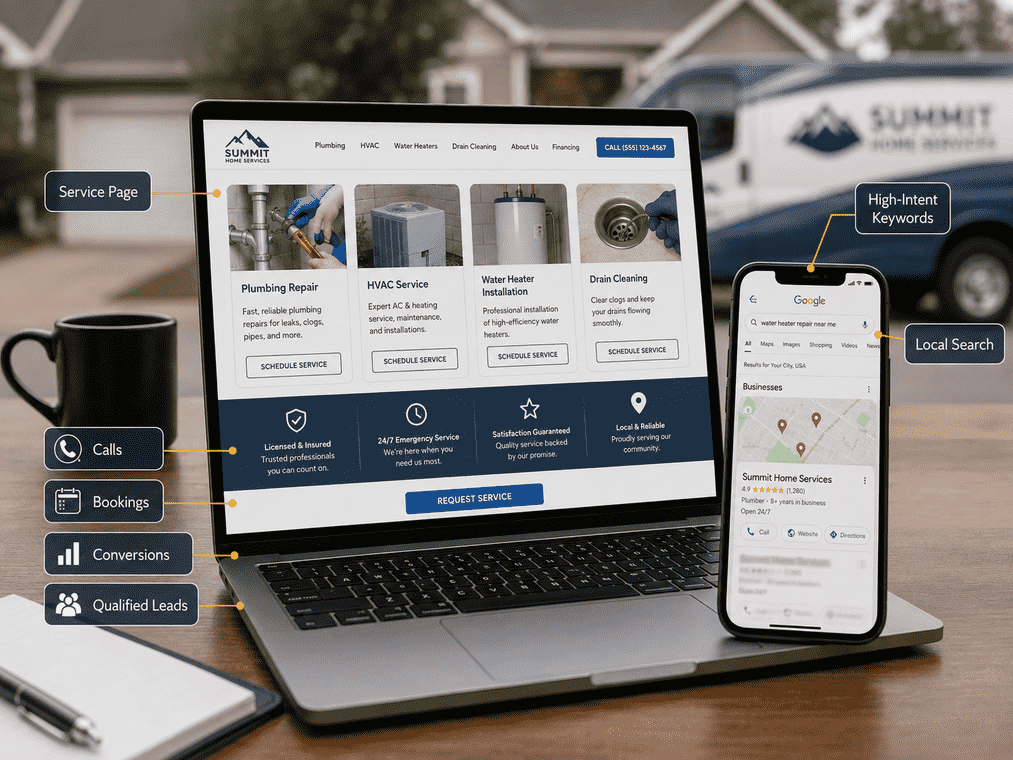
An HVAC company may need separate pages for AC repair, furnace repair, heat pump installation, HVAC maintenance, and indoor air quality services.
A restoration company may need pages for water damage restoration, water extraction, structural drying, mold remediation, fire damage restoration, and storm cleanup.
Dedicated service pages make it easier to target specific search intent while giving customers a clearer explanation of how you can solve their problem.
At Legacy Digital Marketing, we build service pages around actual search opportunities. Every page should have a clear purpose, answer useful questions, target a distinct service, and fit naturally within the website structure.
Location Pages Help Businesses Reach More Markets
Many home service businesses serve several cities, towns, or counties.
That creates opportunities to build visibility outside the company’s primary location.
Well-planned location pages can help search engines understand where your services are available while giving customers useful local information.
A strong location page may include:
- Services offered in the area
- Local service considerations
- Neighborhoods or communities served
- Common customer questions
- Service availability
- Clear contact options
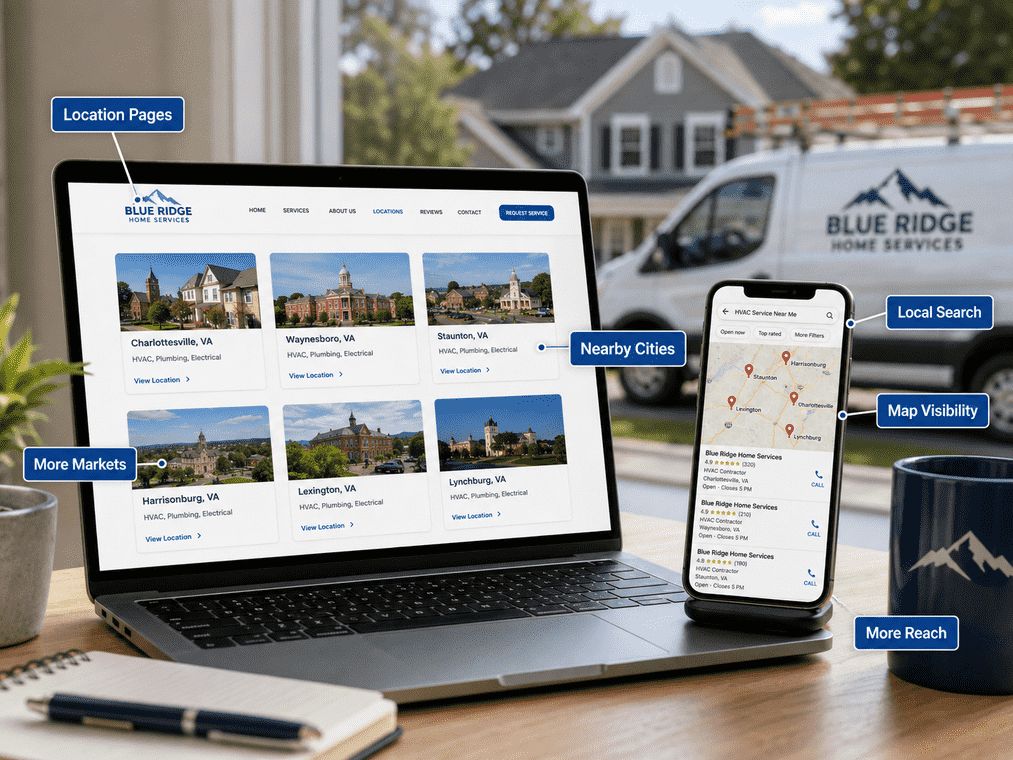
The key is making each page useful.
Creating dozens of nearly identical pages and changing only the city name may add more URLs to a website, but it does not automatically create stronger local rankings.
Location SEO works best when each page has a real purpose and supports an actual market your business wants to grow in.
Reviews Help Turn Visibility Into Trust
Getting found is only the first step.
The customer still has to choose your business.
In 2026, 72% of consumers considered three or fewer businesses before making a local decision, while only 6% simply chose the first result they saw.
That means ranking highly can get you into the conversation, but trust often determines who gets the call.
Reviews are a major part of that decision.
In 2026:
- 92% of consumers considered star ratings when choosing a business.
- 31% would only use businesses rated 4.5 stars or higher.
- 47% would not use a business with fewer than 20 reviews.
- 74% cared most about reviews written within the previous three months.
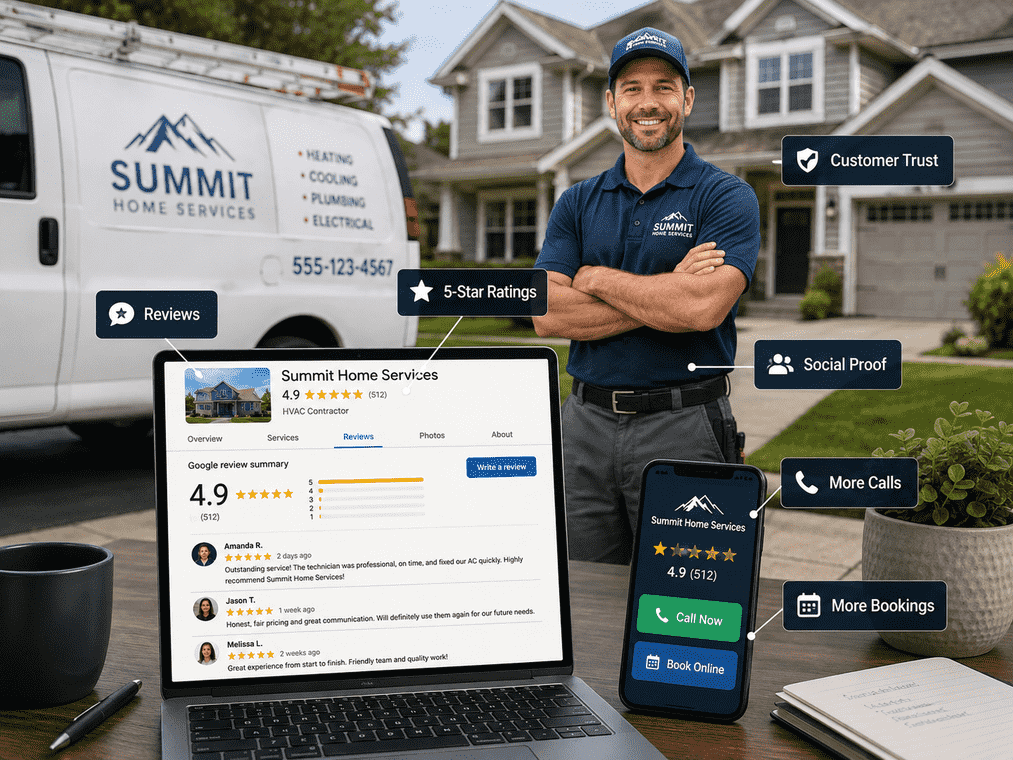
For home service businesses, this matters even more because customers may be letting technicians into their homes or trusting a contractor with an expensive repair.
A steady flow of legitimate reviews helps build confidence and supports your local search presence at the same time.
That is why review management should be part of your SEO strategy, not treated as a separate task.
Helpful Content Builds Authority Before the Customer Calls
Not every homeowner begins by searching for a contractor.
Some start with a question.
They may search:
- Why is my AC blowing warm air?
- Why does my drain keep clogging?
- How do I know if my roof has storm damage?
- Does homeowners insurance cover water damage?
- Why does my circuit breaker keep tripping?
These searches happen earlier in the buying process, but they are still valuable.
Helpful content allows your business to appear before the customer is ready to book a service.
It also helps build topical authority around the services you want to rank for.
For example, a drain cleaning company should not only have a drain cleaning service page. It can also answer questions about slow drains, recurring clogs, sewer backups, hydro jetting, grease buildup, and warning signs that professional drain cleaning is needed.
When those pages are connected through strong internal linking, the website becomes easier for customers and search engines to understand.
This is where content strategy matters.
Publishing random blog posts may increase the number of pages on your website, but a connected content strategy can strengthen the services that actually generate revenue.
Mobile SEO Helps Turn Searches Into Calls
Local search is heavily mobile.
With 73% of local business searches starting on a mobile phone, your website needs to work just as well on a phone as it does on a desktop.
A homeowner dealing with an overflowing drain or broken air conditioner does not want to search through several pages for a phone number.
Important actions should be obvious:
- Call the business
- Request service
- Schedule an appointment
- Get an estimate
- View services
- Check service areas
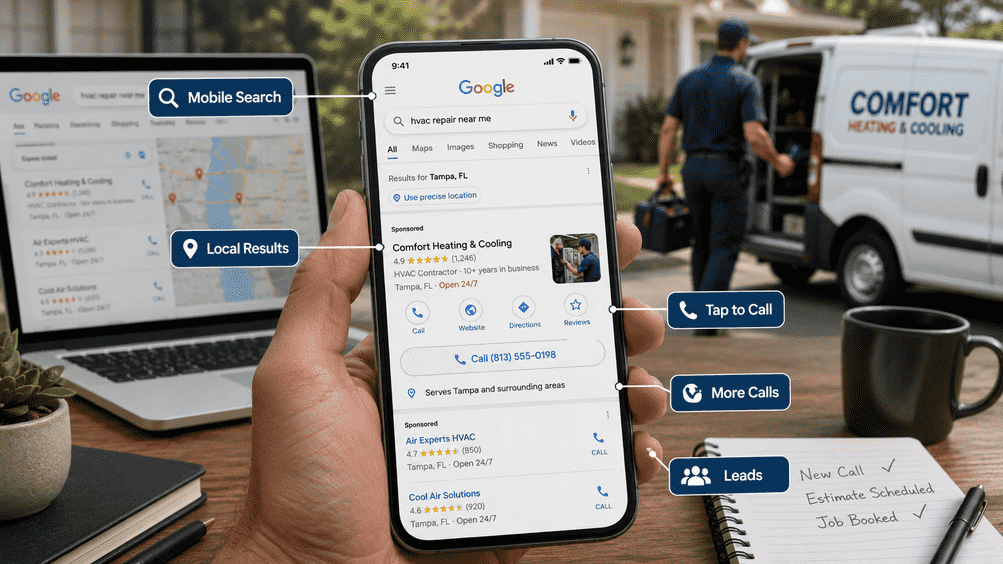
Page speed, navigation, readability, button placement, and contact options all affect whether a visitor becomes a lead.
SEO can bring the customer to your website.
The website still has to make the next step easy.
That is why Legacy Digital Marketing looks beyond rankings. If organic traffic goes up but calls and booked jobs do not, the strategy still has work to do.
Technical SEO Supports Everything Else
Good content cannot perform at its best if search engines have trouble crawling, indexing, or understanding the website.
Technical SEO provides the foundation.
Important areas include:
- Crawlability
- Indexing
- XML sitemaps
- Internal linking
- Canonical URLs
- Redirects
- HTTPS
- Mobile usability
- Site architecture
- Page performance
- Duplicate content management
- Structured data
Many technical problems are not obvious to the business owner.
A page can look perfectly normal while being indexed incorrectly, competing with another page, buried too deep in the website, or sending confusing signals to search engines.
As a home service website grows, technical SEO becomes even more important because service pages, location pages, blogs, and other content need to work together without creating conflicts.
Backlinks and Local Authority Help You Compete
Strong content is important, but competitive markets often require more.
Search engines also consider signals that help establish the prominence and authority of a business.
Relevant backlinks, citations, reviews, and brand mentions can all strengthen that presence.
Useful sources may include:
- Industry associations
- Local chambers of commerce
- Manufacturer directories
- Supplier websites
- Local news sites
- Community organizations
- Professional directories
- Relevant business partners
The goal is not to build hundreds of random links.
The goal is to establish a legitimate digital footprint around your business.
A company that is consistently mentioned, reviewed, linked to, and accurately represented across relevant sources sends much stronger trust signals than one that exists only on its own website.
SEO Also Supports Visibility in AI Search
Search behavior is continuing to change.
Customers can now discover businesses through Google Search, Google Maps, AI Overviews, AI Mode, ChatGPT, Gemini, Copilot, Perplexity, and other AI-powered search experiences.
That does not mean traditional SEO is becoming obsolete.
The same core principles still matter.
Your content should be crawlable, well organized, factually accurate, internally linked, and clear about what your business does.
Your online presence should make it easy to identify:
- Your brand
- Your services
- Your service areas
- Your expertise
- Your credentials
- Your customer reviews
- Your service process
- Your answers to common questions
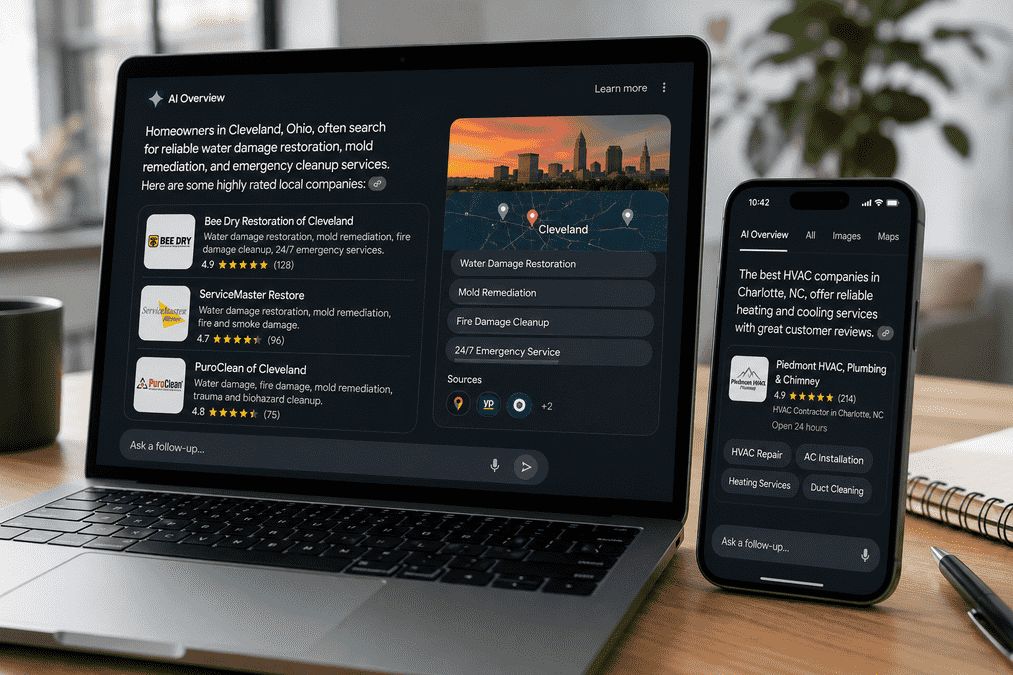
This is where SEO and generative engine optimization begin to overlap.
AI systems need clear, consistent, useful information to understand a business.
No SEO company can guarantee that ChatGPT, Gemini, Copilot, Perplexity, or Google AI will cite a specific page. What we can do is create a stronger digital foundation that makes your business easier for search engines and AI systems to discover and understand.
SEO Can Reduce Dependence on Paid Leads
Paid advertising can produce leads quickly.
The tradeoff is that visibility usually drops when the spending stops.
Organic SEO works differently.
A service page that earns strong rankings can continue bringing in traffic. A well-optimized Google Business Profile can continue generating calls. A useful article can keep attracting potential customers long after it is published.
SEO still requires investment in strategy, content, technical improvements, reputation management, and authority building.
The difference is that you are building marketing assets that can continue creating value over time.
For many home service businesses, the best goal is not to eliminate paid advertising completely.
It is to build enough organic visibility that the company does not have to depend on paid leads for every new customer.
That creates a more balanced and sustainable marketing strategy.
How Should Home Service Businesses Measure SEO Results?
Rankings matter, but they should not be the final goal.
Business owners should track metrics that connect SEO directly to growth.
The most useful include:
- Qualified organic leads
- Phone calls
- Form submissions
- Estimate requests
- Booked jobs
- Organic conversion rate
- Google Maps visibility
- Google Business Profile interactions
- Cost per qualified lead
- Customer acquisition cost
- Revenue from organic search
A keyword moving from position 15 to position 5 is progress.
A keyword generating profitable jobs is business growth.
The best SEO strategy understands the difference.
Why Home Service Businesses Benefit From an SEO Partner
A business owner can learn SEO.
The challenge is finding the time to manage everything required to do it well.
A complete strategy may involve keyword research, competitor analysis, Google Business Profile optimization, technical SEO, service pages, location pages, content creation, review management, backlinks, conversion tracking, analytics, and ongoing updates.
That is a lot to manage while also running a business.
At Legacy Digital Marketing, we approach SEO as a growth strategy rather than a checklist of monthly tasks.
We look at where customers are searching, where your business is losing visibility, what competitors are doing well, and which improvements have the strongest potential to generate qualified leads.
Sometimes that means creating new service pages.
Sometimes it means fixing technical problems, improving existing content, strengthening your Google Business Profile, expanding into new locations, or correcting a weak website structure.
Every business operates in a different market.
Your SEO strategy should reflect that.
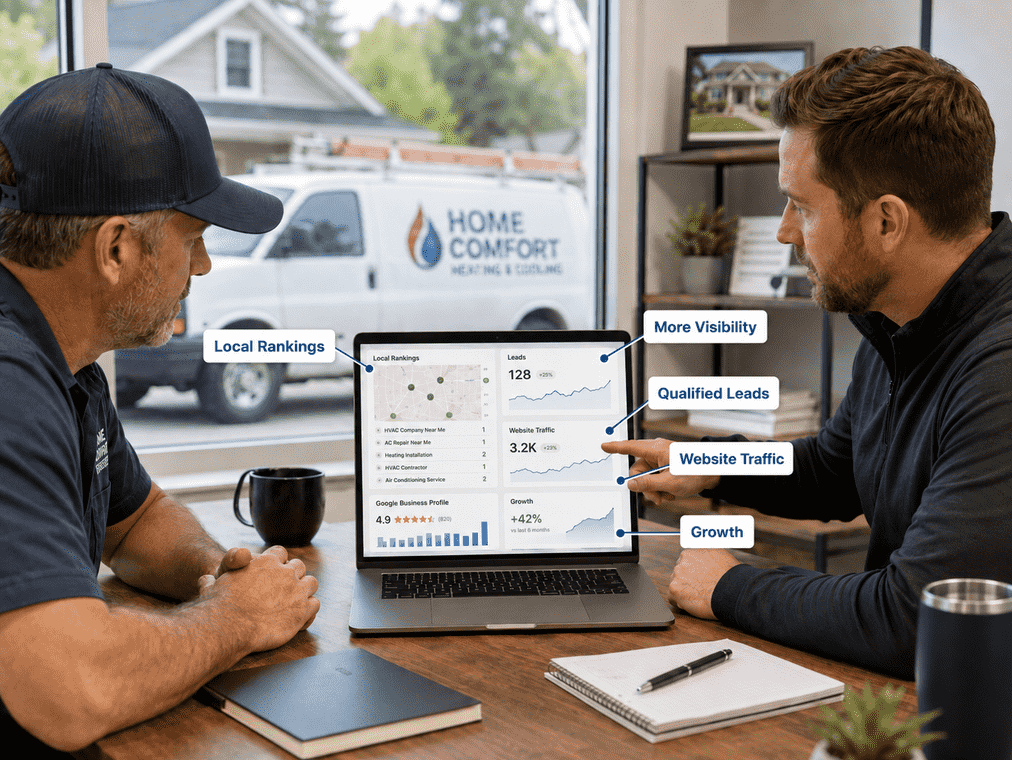
Turn Search Visibility Into Real Business Growth
Home service businesses do not need rankings just to say they rank.
They need homeowners calling, requesting estimates, scheduling appointments, and booking jobs.
SEO helps create that path.
A potential customer searches for a service. Your business appears. Your reviews build trust. Your service page answers the question. Your website makes contacting you easy.
That is how search visibility becomes business growth.
Getting those pieces working together takes more than adding keywords to a website. It requires a coordinated strategy involving local SEO, technical SEO, Google Business Profile optimization, service pages, location pages, useful content, reputation management, backlinks, conversion optimization, and AI search visibility.
Legacy Digital Marketing helps home service businesses build that complete SEO foundation. If you want to improve local visibility, attract more qualified leads, and create a stronger long-term source of organic traffic, contact Legacy Digital Marketing to build an SEO strategy around your services, competition, and target markets.
Frequently Asked Questions
Yes. SEO helps home service businesses reach customers who are actively searching for local services. A strong strategy can improve organic visibility, Google Maps presence, phone calls, estimate requests, website traffic, and qualified leads.
Home service SEO covers the broader organic strategy, including website content, service pages, technical SEO, backlinks, and rankings. Local SEO focuses more heavily on Google Maps, Google Business Profile optimization, reviews, citations, service areas, and location-based searches.
The best keywords depend on the services and locations a company targets. Common opportunities include service keywords, city-based terms, “near me” searches, emergency searches, problem-based keywords, and questions customers ask before hiring a contractor.
Yes. A properly optimized Google Business Profile can help eligible businesses appear in Google Search and Maps. Accurate categories, services, business hours, service areas, reviews, and contact information all support a stronger local presence.
Important services usually benefit from dedicated pages when they have different search intent. Drain cleaning, water heater repair, sewer repair, and emergency plumbing, for example, should generally be treated as separate topics instead of being combined into one generic plumbing page.
There is no fixed timeline. Results depend on competition, website history, technical condition, existing authority, content quality, reviews, backlinks, and the strength of competing businesses in the market.