Use Search Console Data to Find AI-Friendly Topics
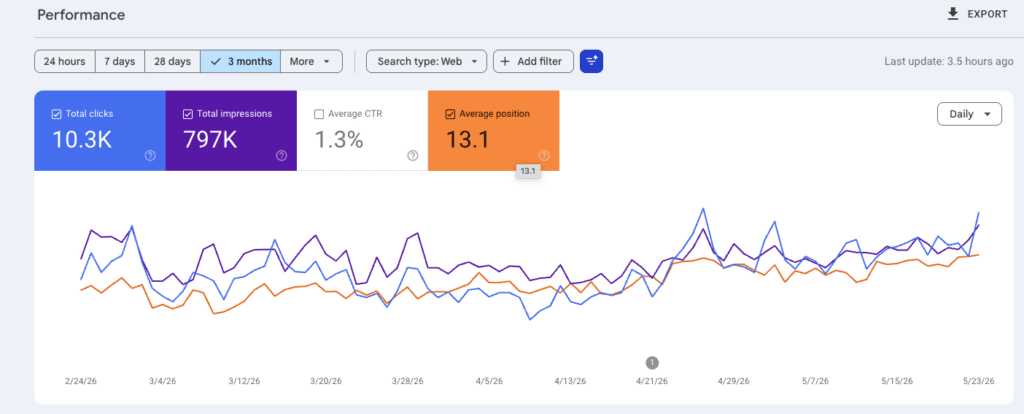
One of the most underrated SEO tools for AI search optimization is Google Google Search Console.
Search Console gives you real search queries users are already finding your website through.
This data is gold.
Why?
Because it reveals:
- User intent
- Real questions
- Emerging search trends
- Long-tail opportunities
- Informational gaps
Many businesses ignore these insights.
Instead, we recommend building entire blog strategies around Search Console queries.
If users consistently search things like:
- “How much does hardwood refinishing cost?”
- “Can I stay in my house during mold remediation?”
- “How long does an HVAC install take?”
…those are excellent AI-focused content opportunities.
AI search engines love content that directly mirrors how real people ask questions.
The more naturally your content aligns with conversational search behavior, the more likely it becomes a source AI systems pull from.
Topical Authority Matters More Than Individual Blogs
Many companies write random blogs without a structured strategy.
AI search engines reward topical authority.
That means building deep content around a niche rather than isolated articles.
For example, if you’re a roofing company, don’t just publish one article about roofing.
Create a complete content ecosystem:
- Roof replacement costs
- Storm damage repair
- Insurance claim help
- Metal roofing guides
- Shingle comparisons
- Emergency tarping
- Roof leak prevention
- Local roofing laws
- Seasonal maintenance tips
When AI systems see your website consistently publishing high-quality content around one topic, your authority increases significantly.
At Legacy Digital Marketing, we often build:
- Topic clusters
- Service page ecosystems
- Internal linking structures
- Location-based authority pages
This helps establish businesses as trusted experts in their field — both for Google rankings and AI citations.
Internal Linking Helps AI Understand Your Website
Internal linking is often overlooked, but it plays a huge role in AI discoverability.
Strong internal linking:
- Helps search engines understand relationships between topics
- Builds topical relevance
- Improves crawlability
- Reinforces authority signals
For example, if you write a blog about:
“How to Prevent Basement Flooding”
You should internally link it to:
- Water damage services
- Sump pump pages
- Mold remediation pages
- Insurance assistance pages
- Related educational blogs
This creates a stronger content network.
AI search systems rely heavily on contextual relationships between content pieces.
The more connected your content ecosystem becomes, the easier it is for AI engines to identify your website as an authoritative source.
Original Insights and Experience Win
One of the biggest mistakes businesses make is creating AI-generated content without adding human expertise.
Ironically, AI search engines often avoid citing generic AI-written content.
Why?
Because there’s no original value.
To stand out, your content should include:
- Real opinions
- Industry observations
- Case studies
- Customer experiences
- Local expertise
- Actual project insights
- Unique recommendations
For example, at Legacy Digital Marketing, we’ve noticed long-form blogs with real operational insights often outperform generic “SEO optimized” content.
We’ve seen businesses generate leads directly from AI tools referencing their blogs because the content provided:
- Detailed answers
- Helpful educational material
- Industry expertise
- Clear user intent matching
AI systems are becoming increasingly sophisticated at identifying authentic expertise versus recycled internet content.
Structured Content Performs Better in AI Search
Formatting matters.
AI search engines prefer content that is:
- Easy to scan
- Well organized
- Structured with headings
- Broken into sections
- Clear and concise
Best practices include:
- H2 and H3 headers
- Bullet points
- FAQ sections
- Short paragraphs
- Conversational writing
- Direct answers early in sections
This improves readability for both users and AI systems.
Think of your content almost like a knowledge base.
The easier it is for AI to extract useful information, the higher your chances of being referenced.
Local Authority Helps AI Visibility
Local businesses have a huge opportunity in AI search.
AI engines often look for:
- Region-specific expertise
- Local relevance
- Trusted local businesses
- Geographic authority
This is why localized content matters.
Instead of generic national blogs, create:
- City-based guides
- Regional service content
- Local case studies
- Area-specific FAQs
- Community-focused resources
For example:
- “How Northeast Ohio Winters Impact Roofing”
- “Common Basement Flooding Causes in Cleveland”
- “What Columbus Homeowners Should Know About Mold”
These types of articles provide highly relevant contextual information AI systems can use.
The Future of SEO Is Becoming the Source
The future of SEO is no longer just about rankings.
It’s about becoming the trusted source AI systems reference.
Businesses that focus only on gaming algorithms will likely struggle moving forward.
The companies that will dominate AI search are the ones that:
- Build real authority
- Demonstrate expertise
- Publish genuinely helpful content
- Answer user questions better than competitors
- Create consistent topical depth
At Legacy Digital Marketing, we believe the future belongs to businesses willing to educate rather than simply advertise.
That means:
- Better blogs
- Better insights
- Better user experiences
- Better answers
Because in the AI era, the brands that provide the best information become the brands users trust most.
And ultimately, those are the brands AI search engines choose to cite.