Social media can help an HVAC company generate more leads, but posting a few equipment photos and seasonal reminders is not enough. Homeowners usually start paying attention to HVAC content when they have a problem, such as an AC that will not cool, a furnace making unusual noises, rising energy bills, or an aging system that may need replacement. Your social media strategy needs to connect with those real situations rather than simply keeping your business page active.
The strongest HVAC social media marketing combines education, local visibility, customer trust, paid advertising, and a clear path to conversion. A homeowner may discover your company on Facebook, watch a technician explain an AC problem on Instagram, search your business on Google, read reviews, visit your website, and then request service. At Legacy Digital Marketing, we approach social media as one part of that larger customer journey, with the goal of turning attention into qualified calls, estimates, appointments, and booked HVAC jobs.
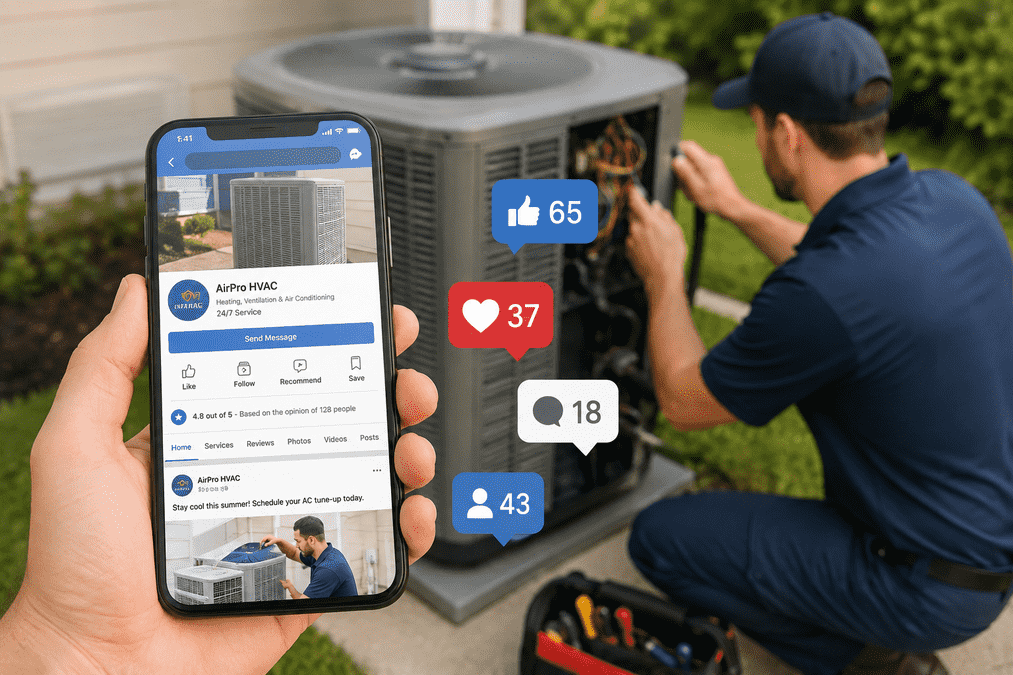
How Can HVAC Companies Get More Leads From Social Media?
HVAC companies can generate more leads from social media by combining helpful content, real project proof, customer trust, and locally targeted advertising. The goal is not to post just for activity. Every post should help educate homeowners, build credibility, or encourage the next step.
A strong HVAC social media strategy can include:
HVAC Tips: Answer common homeowner questions about heating, cooling, maintenance, and system performance.
Real Projects: Share installations, repairs, before-and-after photos, and technician work.
Customer Reviews: Use real feedback to build trust and strengthen social proof.
Short Videos: Create quick technician explanations, maintenance tips, and service demonstrations.
Seasonal Promotions: Highlight AC tune-ups, furnace maintenance, repairs, replacements, and other timely services.
Local Ads: Target homeowners within the HVAC company’s actual service area.
Fast Responses: Reply quickly to messages, comments, and service inquiries.
Social media works best when it connects with the rest of the company’s HVAC digital marketing strategy. Strong landing pages help convert visitors, local SEO improves search visibility, reputation management reinforces trust, and lead tracking shows which campaigns are actually producing calls, appointments, and qualified HVAC leads.
Build Trust Before the Homeowner Needs HVAC Service
Most homeowners only look for an HVAC company when something goes wrong or a system needs repair or replacement. Social media helps your business stay familiar so they are more likely to remember and trust your company when that time comes.
Use real content instead of stock photos and repetitive sales posts. Share technicians, completed jobs, maintenance tips, customer experiences, and common HVAC problems to show genuine expertise and build trust.
Useful trust-building content can include:
- AC and furnace installations
- Heat pump replacements
- Before-and-after projects
- Technician introductions
- Seasonal HVAC maintenance tips
- Customer testimonials
- Local service projects
- Common troubleshooting questions
- Indoor air quality information
- Equipment replacement guidance
The goal is to create a social presence that feels active, knowledgeable, and local. Homeowners should be able to look through your content and quickly understand that your team works on real HVAC systems, serves real customers, and knows how to explain technical problems clearly.
Choose the Right Social Media Platforms
HVAC companies do not need to be active on every social platform. For many residential contractors, Facebook and Instagram are strong starting points because they support local visibility, customer engagement, videos, reviews, messaging, and paid ads.
Facebook is useful for:
Local service updates
Customer recommendations
Seasonal offers
Community engagement
Lead-generation campaigns
Instagram works well for:
Technician videos
Before-and-after projects
HVAC installations
Heat pumps and mini-splits
Maintenance tips
Short educational Reels
YouTube can also support longer educational content if your team has the resources to produce it consistently.
The goal is not to be everywhere. Focus on the platforms you can maintain well and connect them to your broader HVAC digital marketing strategy.
Create HVAC Content Homeowners Actually Want to See
One of the easiest ways to make an HVAC social media page ineffective is turning every post into an advertisement. Repeating “Call today,” “Schedule now,” and “Book your tune-up” gives homeowners little reason to follow the page when they do not currently need service. A stronger strategy balances educational content, project proof, customer experiences, local relevance, and timely promotions.
Your technicians already know what customers want to understand because they hear the same questions during service calls. Those questions can become social posts, short videos, website articles, FAQs, and even paid advertising topics. When your content addresses real homeowner concerns, it demonstrates expertise without needing to constantly tell people how experienced your company is.

Answer Common HVAC Questions
Educational posts should focus on specific problems rather than broad HVAC topics. Questions such as these can produce useful content throughout the year:
- Why is my AC blowing warm air?
- Why does my air conditioner keep freezing?
- How often should I replace my HVAC filter?
- When should I repair or replace my furnace?
- Why are some rooms hotter than others?
- What causes high energy bills?
- How long does an HVAC system last?
- What are the signs of a failing heat pump?
- Why is my furnace making unusual noises?
- How often should HVAC maintenance be scheduled?
Each post can answer the question briefly and direct homeowners to a more detailed service page when professional help is appropriate. This also creates a natural connection between social media and your website instead of treating them as completely separate channels.
Show Real HVAC Projects
Real project content is another strong source of social proof. An actual furnace installation, heat pump replacement, or ductwork project gives homeowners something concrete to evaluate and demonstrates that your company actively performs the services it promotes.
Add useful context rather than uploading a photo with only “Another happy customer.” Explain what problem the homeowner was experiencing, why a particular solution was recommended, or what changed after the installation. When appropriate, mention the city or service area naturally to strengthen local relevance.
Project content works especially well for:
- AC replacements
- Furnace installations
- Heat pump systems
- Ductless mini-splits
- Ductwork improvements
- Thermostat upgrades
- Indoor air quality systems
- Commercial HVAC projects
Real work builds credibility more effectively than generic claims about quality or professionalism.
Turn Customer Reviews Into Social Proof
Customer feedback can also become valuable social media content. Reviews that mention fast service, clear communication, honest recommendations, professional installation, clean workmanship, or a helpful technician address concerns that future customers may already have.
Avoid using the same five-star template for every review. Combine testimonials with project photos, technician images, completed installations, or brief information about the service performed. This makes the content feel more authentic and connects the customer’s experience with a specific type of HVAC work.
Use Short-Form Video to Show HVAC Expertise
Short-form video works well for HVAC because homeowners can quickly see and understand common problems. A technician can explain a frozen coil, clogged drain, dirty filter, or failing component in under a minute while building trust.
Keep each video focused on one problem. Instead of creating a broad video about HVAC maintenance, make several shorter videos about filter replacement, frozen AC systems, thermostat issues, strange furnace noises, or signs that a system is losing efficiency.
A simple structure can keep each video clear:
- Hook: Start with the homeowner’s problem.
- Explain: Describe what may be causing it.
- Show: Point out the relevant component when possible.
- Guide: Explain what the homeowner should do next.
- CTA: Recommend professional service when necessary.
For example, a technician might open with, “If your AC is running but your home keeps getting warmer, these are two things we normally check first.” The viewer immediately understands the problem being discussed and has a reason to continue watching.
This approach also helps humanize the company. Potential customers can see how technicians communicate and explain HVAC issues before anyone arrives at their home.
Use Paid Social Ads Around Specific HVAC Needs
Organic social media helps establish familiarity, while paid advertising allows HVAC companies to reach more homeowners within selected service areas. The most effective campaigns usually focus on a specific service or seasonal need instead of advertising the entire company with a generic message.
Campaigns can change throughout the year based on demand:
- Spring: Schedule an AC tune-up before cooling season.
- Summer: AC not cooling? Request repair service.
- Fall: Get your furnace ready for colder weather.
- Winter: Heating system problems? Schedule furnace repair.
- Replacement: Request an estimate for a new HVAC system.
- Heat Pumps: Explore heat pump installation or replacement.
- Maintenance: Ask about an HVAC maintenance plan.
- Indoor Air Quality: Schedule an indoor air quality evaluation.
Every campaign should have a specific service, target area, offer, and next step. Someone experiencing an AC failure should see different messaging from a homeowner researching a full HVAC replacement. Clearer targeting also makes it easier to evaluate which services are generating the most valuable leads.
Geographic targeting is especially important for local HVAC companies. Advertising to homeowners outside your actual service area can create wasted leads and unnecessary follow-up work, so campaigns should reflect the cities and communities your technicians can realistically serve.
Send Social Media Leads to the Right Page
A strong advertisement can still waste money if the destination does not match the message. Someone who clicks an ad for AC replacement should not land on a generic homepage and then have to search for information about replacement services. The landing page should continue the exact conversation started by the advertisement.
A strong HVAC landing page should include:
- Service-specific headline
- Clear description of the service
- Areas served
- Relevant benefits
- Real project photos
- Customer testimonials
- Credentials where applicable
- Financing information when available
- Visible phone number
- Short contact form
- Strong call to action
- Mobile-friendly design
If the ad promotes an HVAC replacement estimate, requesting an estimate should be the obvious next step. If the campaign promotes emergency AC repair, phone and service-request options should be immediately visible.
This is where social media and conversion rate optimization work together. Social media creates interest, but the landing page has to turn that interest into a qualified lead.
Use Retargeting and Follow-Up to Recover More Opportunities
Not every HVAC customer makes a decision immediately. Emergency repairs may result in quick calls, while expensive replacements often involve additional research, multiple estimates, financing questions, warranty comparisons, and discussions with other household members. Retargeting can help keep your HVAC company visible while those homeowners continue evaluating their options.
Retargeting content should provide new information rather than repeatedly displaying the same sales message. Useful topics include:
- Customer testimonials
- HVAC replacement benefits
- Financing information
- Warranty details
- Installation processes
- Maintenance memberships
- System efficiency information
- Completed replacement projects

The lead-response process is equally important. Someone submitting a form, sending a message, or asking about AC repair may continue contacting other HVAC companies, so your team needs a clear process for handling incoming inquiries.
Keep initial lead forms simple and collect only the information required to start the conversation:
- Name
- Phone number
- ZIP code
- Service needed
- Repair or replacement
- Whether the system is currently working
More detailed questions can be asked after contact is established. At Legacy Digital Marketing, we treat lead follow-up as part of campaign performance because generating inquiries has little value if qualified homeowners are lost before the appointment is scheduled.
Connect Social Media With Local SEO and Your Website
Social media should support the rest of your online presence. A homeowner may discover your HVAC company on Facebook, search your brand later, check your Google Business Profile, read reviews, visit a service page, and eventually call. Each channel should reinforce the same company, services, service areas, expertise, and reputation.
Keep core information consistent across your online presence, including:
- Business name
- Phone number
- Website
- Business hours
- Service areas
- HVAC services
- Branding
- Company description
Your social content should also connect naturally with service pages and educational content on your website. A social post explaining why an AC system freezes can point homeowners toward an AC repair page, while a heat pump installation project can connect with your heat pump service content.
This creates clearer relationships between important topics and entities:
HVAC Company → Service → Customer Problem → Solution → Service Area → Expertise → Reviews → Project Proof → Contact
These relationships are valuable for customers, traditional search engines, and AI-powered discovery systems because they make your business easier to understand. Social media does not guarantee Google rankings or AI citations, but a consistent and authoritative digital footprint can strengthen how clearly your brand is represented online.
Measure Leads and Revenue, Not Just Engagement
Social media metrics such as followers, likes, views, shares, and impressions can show whether people are seeing your content, but they should not be the final measure of success. An HVAC company needs to know whether social activity contributes to qualified opportunities and revenue.
Track business-focused metrics such as:
- Leads generated
- Qualified leads
- Phone calls
- Direct messages
- Form submissions
- Estimates scheduled
- Service appointments
- Jobs booked
- Cost per lead
- Cost per qualified lead
- Customer acquisition cost
- Revenue generated
- HVAC systems sold
- Maintenance plans sold
Lead quality should be evaluated alongside lead volume. A campaign producing many inexpensive inquiries may be less profitable than one producing fewer homeowners who are ready to purchase high-value HVAC replacements.
Connect advertising data with your CRM, call tracking, and sales process whenever possible. The goal is to understand which content, campaigns, services, and audiences actually contribute to booked work.
Keep Your HVAC Social Media Strategy Consistent
HVAC companies do not need to post constantly to build a useful social presence. A predictable schedule with relevant content is easier to maintain and gives your audience a healthy mix of education, proof, customer experiences, and service offers.
A simple weekly content plan might include:
- Monday: HVAC tip or homeowner question
- Tuesday: Recent repair or installation
- Wednesday: Technician video
- Thursday: Customer review or team spotlight
- Friday: Seasonal reminder or service promotion
Adjust the topics based on the season. Cooling months naturally support content around AC repair, maintenance, refrigerant issues, airflow problems, and system replacement. As colder weather approaches, shift toward furnace maintenance, heating repair, heat pumps, and winter preparation.
Consistency matters more than trying to publish as often as possible. A smaller number of useful posts that demonstrate real expertise will usually create a stronger brand than a feed filled with repetitive promotions.
Turn Social Media Into Part of Your HVAC Lead-Generation System
Social media can become a valuable source of HVAC leads when it works as part of a complete marketing strategy. Educational content builds expertise, technician videos humanize the brand, reviews create trust, project photos provide proof, paid advertising creates opportunities, landing pages convert interest, and fast follow-up helps turn those inquiries into appointments.
The strongest strategy connects HVAC social media marketing, local SEO, Google Business Profile optimization, website content, reputation management, paid advertising, conversion optimization, and lead tracking. Homeowners move between these channels naturally, so the experience should remain consistent wherever they encounter your company.
At Legacy Digital Marketing, we help HVAC businesses connect these pieces into a practical digital marketing strategy focused on qualified leads rather than vanity metrics. When social media is planned around real customer questions, local demand, strong offers, and measurable outcomes, it can become much more than another place to post. It can become a useful part of your overall customer acquisition strategy.
Frequently Asked Questions
HVAC companies can generate more leads by sharing useful educational content, showing real projects, publishing customer experiences, running locally targeted advertising, and promoting services that match seasonal demand. Strong landing pages, easy contact options, and fast follow-up are equally important because social engagement only becomes valuable when interested homeowners can move easily toward an appointment or estimate.
Facebook and Instagram are practical starting points for many residential HVAC companies because they support local audiences, videos, photos, messaging, community engagement, and paid advertising. YouTube can also be valuable for more detailed educational content, while short-form video platforms can extend the reach of quick technician explanations and troubleshooting content.
Facebook advertising can generate HVAC leads when campaigns promote a clear service, target appropriate geographic areas, and provide homeowners with a specific next step. AC repair, furnace service, heat pump installation, maintenance, and system replacement can all be promoted effectively when campaigns are measured through qualified leads and booked jobs instead of clicks alone.
There is no fixed posting frequency that guarantees more HVAC leads. A company that consistently publishes several useful posts each week can build a strong presence without posting every day. Quality, local relevance, consistency, and customer engagement matter more than creating large amounts of repetitive content.
Yes. Short videos allow HVAC technicians to explain common problems, show equipment, demonstrate maintenance, and highlight completed work in a format homeowners can understand quickly. Video also helps build familiarity because potential customers can see the technicians and communication style behind the company before scheduling service.
Track qualified leads, phone calls, messages, estimates, appointments, booked jobs, cost per lead, customer acquisition cost, and revenue generated from social campaigns. Engagement metrics can provide additional context, but the most valuable measurement connects social media activity with real sales and completed HVAC work.
Working with a digital marketing agency can be useful when an HVAC company does not have the internal resources to manage content, paid advertising, landing pages, conversion tracking, local SEO, and campaign optimization consistently. Legacy Digital Marketing helps connect these areas into a broader strategy focused on visibility, qualified leads, and measurable business growth.